Jean-Michel Loubes
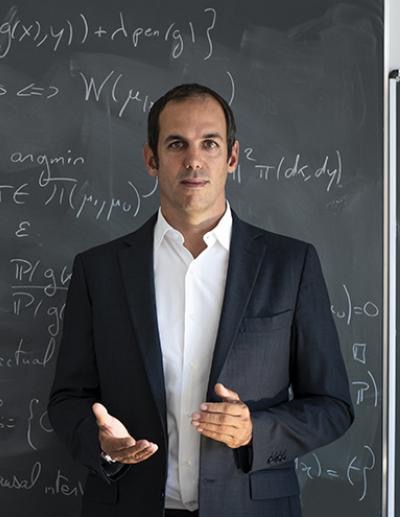
- Research Director @ Inria, on leave from Professor of Mathematics (Exceptional Class) at the University of Toulouse, Institut de Mathématiques de Toulouse.
- Head of the Regalia Lab (Regulation of AI).
- Principal Investigator, Chair TRIAL (Trustworthy AI & Machine Learning) @ ANITI.
- Scientific Direction at the French AI Safety Institute (INESIA) and Director of the national program on AI evaluation.
Expertise: Mathematical Statistics, Machine Learning, Optimal Transport, Evaluation of Artificial Intelligence, Trustworthy AI (Fairness, Robustness, Reliability and Explainability).
Contact:
✉ jean-michel.loubes@inria.fr
News
- October 2026 TrackLLM is online: it continuously monitors LLM APIs to detect undisclosed changes of the models behind them, building on our ICML 2026 paper Token-Efficient Change Detection in LLM APIs and its black-box detection of model changes from border inputs.
- September 2026 Kick-off of the national program on evaluation of AI (INESIA).
- September 2026 Our article Minimax Private Estimation of Smooth Optimal-Transport Maps (Clément Lalanne, David Rodríguez-Vítores, Franck Iutzeler, Jean-Michel Loubes) has been accepted to the 40th Conference on Neural Information Processing Systems (NeurIPS 2026).
- July 2026 Three papers at ICML 2026 in Seoul, including one spotlight: Exact Functional ANOVA Decomposition for Categorical Inputs Models (Baptiste Ferrere, Nicolas Bousquet, Fabrice Gamboa, Jean-Michel Loubes, Joseph Muré) — Spotlight; Token-Efficient Change Detection in LLM APIs (Timothée Chauvin, Clément Lalanne, Erwan Le Merrer, Jean-Michel Loubes, François Taïani, Gilles Tredan); and Correcting Overparameterization Effects in Fair Empirical Risk Minimization (Xiaoyi Mai, Jean-Michel Loubes).
- 2026 Two papers accepted at IEEE SaTML 2026: Evaluating Black-Box Vulnerabilities with Wasserstein-Constrained Data Perturbations (with Adriana Laurindo Monteiro) and Homophily-aware Supervised Contrastive Counterfactual Augmented Fair Graph Neural Network (with Mahdi Tavassoli Kejani, Fadi Dornaika and Charlotte Laclau).
- December 2025 Talk "When majority rules, minority loses" at the EurIPS 2025 workshop Unifying Perspectives on Learning Biases, Copenhagen.
- 2025 Creation of the Inria research team Regalia — Regulation of AI.
- 2025 Our article When majority rules, minority loses: bias amplification of gradient descent has been accepted to NeurIPS 2025.
- 2025 Teaching "Fairness and Statistics" at the Institut Henri Poincaré.
- 2025 Speaking at the World AI Summit 2025.
- 2024 Member of the AFNOR / CEN-CENELEC committee on AI standards.
- 2024 Appointed Research Director at Inria.
Curriculum
Education
- 2006: Habilitation à Diriger des Recherches (HDR), University of Montpellier II
- 2001: PhD in Applied Mathematics (Statistics), University Toulouse III & Leiden University, supervised by Sara van de Geer
- 1998: Agrégation of Mathematics
- 1995–1998: École Normale Supérieure de Cachan (now ENS Paris-Saclay); Master in Mathematics, University Paris VII
Appointments
- 2025–today: Scientific Direction at the French AI Safety Institute (INESIA) and Director of the national program on AI evaluation
- 2025–today: Head of the Regalia Lab (Regulation of AI), Inria
- 2024–today: Research Director at Inria, on leave from the University of Toulouse
- 2019–today: Principal Investigator, Chair TRIAL (Trustworthy AI & Machine Learning) at ANITI, renewed 2023–2027
- 2018–2020: Scientific Director of the DEEL team (Dependable, Explainable and Embeddable Learning), IRT Saint Exupéry
- 2007–2024: Professor of Applied Mathematics at the University of Toulouse, Institut de Mathématiques de Toulouse (First Class 2013, Exceptional Class 2019)
- 2005–2007: CNRS Researcher in Mathematics, University Montpellier II
- 2002–2005: CNRS Researcher in Mathematics, University Paris XI Orsay (now Paris-Saclay)
Honours
- 2024–today: Member of the AFNOR / CEN-CENELEC committee on AI standards; representative of Inria (2024–2025)
- 2020–2024: Member of the Scientific Council of CNRS Mathematics (INSMI)
- 2019–2023: Deputy President of the University of Toulouse, in charge of innovation for industry
- 2019: CNRS Innovation Award, for the development of explainable machine learning tools
- 2016–2020: Member of the National Council of Universities (CNU)
- 2016–2020: Member of the Scientific Council of the University of Toulouse
- 2011: Co-creation and direction of AMIES, the French agency for mathematics in interaction with industry and society
- 2008–today: Research Excellence Award (PEDR), renewed every four years
A detailed CV is available here.
Research
Trained as a mathematician, I began by modelling complex systems driven by randomness: building statistical models that estimate their structure and forecast their behaviour, from road traffic to inverse problems and deformations of curves and distributions. This work has always been tied to industry, which I see both as a field of application for mathematics and as a source of new mathematical problems.
My work then moved to machine learning, with applications in industry and biology: anomaly detection and predictive maintenance in aerospace and manufacturing, and the analysis of genomic and metagenomic data. These collaborations led to industrial patents and to more than fifteen research contracts and industrial PhDs with partners such as Airbus (EADS), Continental, Michelin, L'Oréal, Total, EDF and Liebherr Aerospace.
As machine learning came to make decisions that affect people, I turned to trustworthy AI: robustness, bias and fairness, and explainability, using tools such as optimal transport and sensitivity analysis. A better AI is not only a mathematical question, so this work is multidisciplinary, carried out with lawyers, economists and specialists of governance and regulation.
Today my research focuses on the evaluation of AI. Evaluation is the starting point for a better and safer AI: a system can only be trusted, regulated or improved once its behaviour can be measured. This is the aim of the Regalia team at Inria and of the national program on AI evaluation at INESIA.
Selected publications
Evaluation of AI
- ICML
- ECCV
- NeurIPS
- JMLR
Optimal Transport and Applications
- NeurIPS
- SIMODS
- Ann. Probab.
- PTRF
Machine Learning
- ICML
- ICML
- Ann. Statist.
- JMVA
- Inf. Inference
Teaching
- Fairness and Statistics: Institut Henri Poincaré (IHP), 2025.
- Master 2 MAPI3: Applied Mathematics for Engineering, Industry and Innovation, University of Toulouse. Former director of the Master in Machine Learning (40 students per year).
- AI regulation: Training courses through CNRS Formation, and for journalists, public administration, the military and industrial groups (2018–present).
Post-Doc or visiting students
- Rodrigo Maulen-Soto (2026–): Optimization and machine learning for AI evaluation
- Clément Lezane (2025–): Optimization and machine learning
- Adriana Monteiro (2024): Fairness in machine learning
- David Rodríguez-Vítores (2024): Optimal transport and applications
- Renan Del Buono Brotto (2022): Inverse problems and deep learning
- Marina Agulló Antolín (2018): Trimming and optimal transport
PhD students
Current: Valentin Lafargue (CIFRE TFC); Baptiste Ferrere; Veronika Shilova (CIFRE L'Oréal & Artefact); Mahdi Tavassoli Kejani (TUPLES European project); Sena Ozgunay (CIFRE Continental); Elena Marti de Diego (University of Navarra).
Former (28): Gayane Taturyan, Marouane Il Idrissi, William Todo, Lucas De Lara, Alberto Gonzalez Sanz, Clément Benesse, María Andrea Arias Serna, Camille Champion, Paula Gordaliza, Eva Jaidan (published as Eva Jabbar), Thi Thien Trang Bui, Benoît Sainct, Clémentine Barreyre, Brendan Guillouet, Anne-Claire Brunet, Lee Dinetan, Mélanie Blazère, Hélène Lescornel, Maikol Solís, Santiago Alejandro Gallón Gómez, Chloé Dimeglio, Jean-Noël Kien, Jérémie Bureau, Thibault Espinasse, Paul Rochet, Lilian Muñiz Alvarez, Yanwen Yan, Guillaume Allain.
→ Post-Doc, visiting and PhD students: full list with topics, dates and current positions
Resources
- Stakes of evaluating AI systems (in French) — CLUSIF
- Bias, robustness and explainability of AI under the EU AI Act — training with CNRS Formation (2024) — LinkedIn
- Seminar at IRT SystemX — IRT SystemX
- 3 questions to understand artificial intelligence (in French) — Université de Toulouse
- Machine Learning NeEDS Mathematical Optimization — NeEDS — Network of European Data Scientists
- Trust and loyalty of AI-based decisions — ANITI Toulouse
In the press
- Le chercheur : les mathématiques, l’IA et l’éthique — Boudu, 2025
- Stéréotypes, inégalités et « généralisation » : pourquoi les intelligences artificielles génératives sont-elles sexistes ? — franceinfo (radio), 2025
- « Il faut que l’humanité soit prête à vivre avec l’intelligence artificielle », explique un expert — La Dépêche du Midi, 2023
- Toulouse : des chercheurs traquent les failles de l’intelligence artificielle afin d’éviter qu’elle déraille — La Dépêche du Midi, 2023
- Les bugs de l’intelligence artificielle — Le Monde, 2019
- La fin de la science ? — Le Monde, 2014
- Jean-Michel Loubes : « L’IA est le reflet de notre humanité » — Sciences en Occitanie
- Jean-Michel Loubes, le mathématicien qui enseigne aux machines — Exploreur, Université de Toulouse
- Innovation et réglementation, entre stabilité juridique et dynamisme technologique (podcast) — Data Ring — Les Causeries Data